Updated August 2026 · USP Consultancy · Colombia. General information, not legal or immigration advice; your timeline depends on your specific case.
Key takeaways
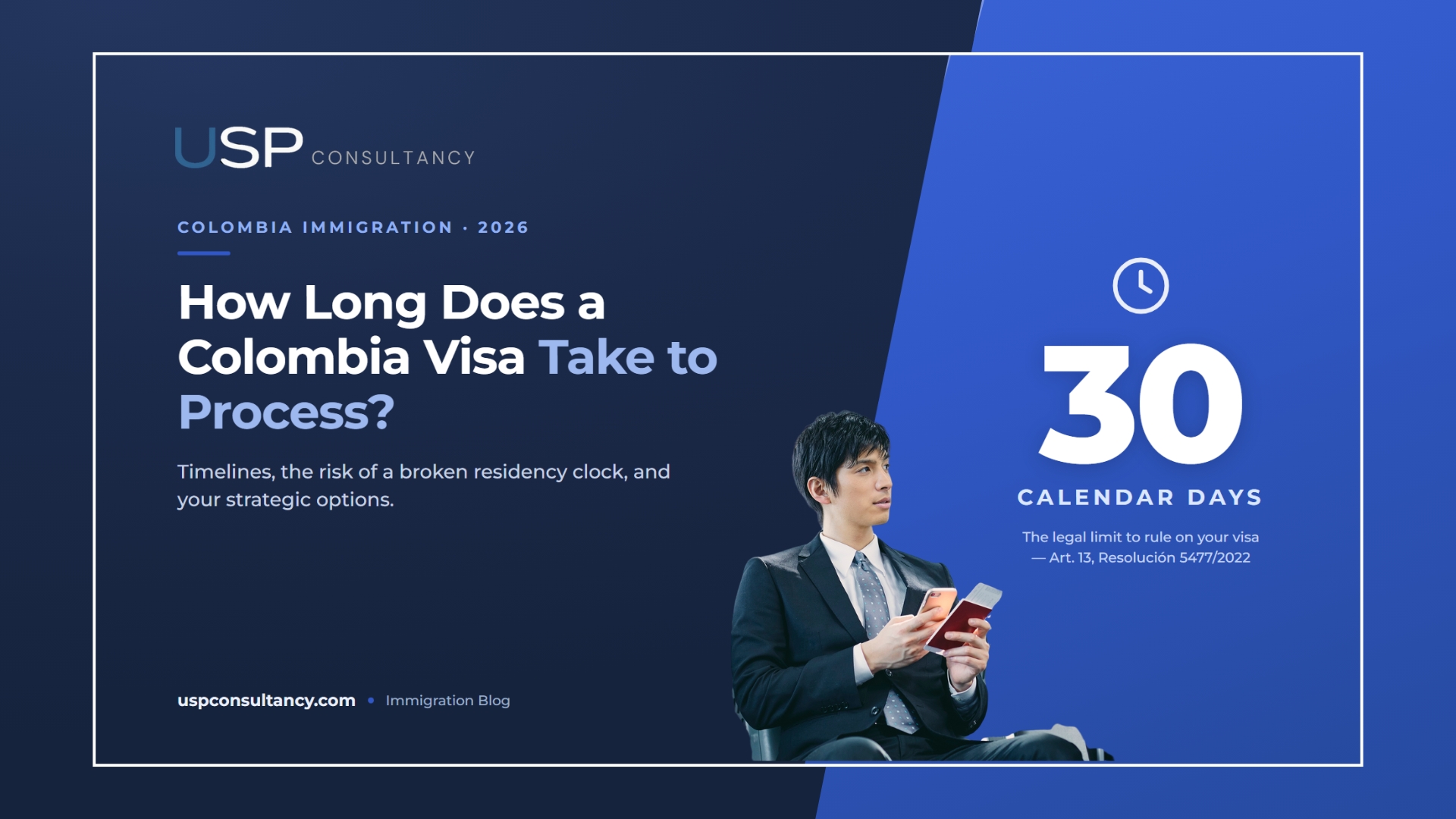
- By law, the Visa Authority has up to 30 calendar days to rule once your file is complete and the study fee is paid (Article 13, Resolution 5477 of 2022) — and it can run longer if other agencies must be consulted.
- In practice during 2026, operational congestion is adding up to about two extra weeks on renewal and continuity applications.
- For Migrant (M) category holders building time toward residency, a lapse during processing can break visa continuity and reset the clock to zero.
- Your options depend on your status when you apply: a 30-day window if a visa expires mid-process, or a salvoconducto if your tourist days run out.
In this guide
“How long will my visa take?” is the first question almost every applicant asks — and the honest answer has two layers. There is what the regulation promises, and there is how the Ministry of Foreign Affairs’ workload actually plays out in 2026. The gap between the two is where people get hurt, especially anyone counting on an uninterrupted path to residency.
The regulatory framework is explicit about institutional timelines. Article 13 of Resolution 5477 of 2022 states, in essence:
§ Article 13, Resolution 5477 of 2022 — Application processing time
“Once the application is fully completed, with all required documents submitted and the corresponding study fee paid, the Visa and Immigration Authority shall have up to thirty (30) calendar days to issue its ruling. When the study and document-verification process requires consulting other entities, the response time may exceed this period. If the foreign applicant is in Colombia, they must remain in a regular immigration status for the entire duration of processing — whether under a valid visa, a Salvoconducto, or a permanence permit.”
Understanding the rule is only the first step. The real challenge is how that 30-day promise behaves under load, and what alternatives you have to protect your process when it slips.
What the law actually says: the 30-day rule
Three details inside Article 13 matter more than the headline number:
The clock starts when your file is complete — not when you begin. The 30 calendar days only run once every required document is uploaded and the study fee is paid. An incomplete or mis-assembled file doesn’t start a shorter clock; it starts no clock at all. This is exactly why a clean, complete submission on day one is worth more than any shortcut later.
The 30 days can legally be exceeded. The regulation itself contemplates a longer response “when the study and document-verification process requires consulting other entities.” That is not an abuse of the rule — it is written into it. Certain profiles and document checks trigger inquiries between entities that stretch the timeline by design.
You must stay regular the whole time. If you’re inside Colombia while your application is pending, you are required to hold a regular status for the entire duration — a valid visa, a salvoconducto, or a permanence permit. Falling out of status during the wait is its own problem, separate from the decision on your visa.
The 2026 reality: congestion adding up to two weeks
Although the regulation sets a 30-calendar-day standard and allows extensions for inquiries between entities, severe operational congestion is currently pushing past the traditional deadlines.
⚠️ What we’re seeing: in 2026, renewal and continuity applications are running up to roughly two weeks longer than the standard timeframe. This is an operational pattern we observe in current casework — not a published figure — and it can shift as workloads change. Plan against it rather than assuming the 30-day minimum.
For most first-time applicants, an extra couple of weeks is an inconvenience. For one group it is a genuine risk: holders of a Migrant (M) category visa who are accumulating time toward residency. If your current visa expires during the wait and approval is delayed, the continuity between your visas can break — and a broken chain nullifies the time you’ve accumulated, forcing you to start the countdown to residency again from zero.
Why timing is critical for Migrant (M) visa holders
Colombia’s path to permanent residency rewards uninterrupted time on the right visa. The Resident (R) visa is generally reached after a qualifying stretch of continuous years on an M visa. The word doing the heavy lifting is continuous: the value isn’t just the years, it’s the unbroken chain.
🕑 The trap: a processing delay by itself doesn’t hurt you — a lapse does. If your old visa expires before the new one is granted, the gap can reset your accumulated time, no matter how many years you were into the path to the Resident (R) visa. The fix is almost always timing: apply early enough that the decision lands before your current visa runs out.
This is why we push applicants to file well ahead of expiry rather than at the last legal moment. The 30-day rule plus a possible two-week congestion buffer means the safe move is to start weeks earlier than feels necessary.
Your status changes your options
What you can do while you wait depends on how you’re standing in the country at the moment you apply. The two most common situations behave very differently:
| Your visa expires during processing | You’re on tourist days (permanence permit) | |
|---|---|---|
| Can you stay while you wait? | Yes — generally a 30-day window to remain in a regular status | Only while your tourist days last; once they run out you must act |
| Do you need a salvoconducto? | Not strictly required within that 30-day window | Yes — request a SALVOCONDUCTO to avoid falling into irregularity |
| Effect on continuity to residency | If approval is late, the chain between visas may already be broken — even inside a legal grace window. Continuity is about the visa dates, not just staying regular. | |
Source: Resolution 5477 of 2022 (Art. 13) and USP Consultancy casework, 2026. Confirm the specifics of your case before acting.
The distinction people miss is this: staying in the country legally and preserving your path to residency are two different things. A grace window keeps you regular; it does not, on its own, protect the unbroken chain of visa dates that residency depends on.
Applying from abroad: the consulate route
Facing the bottleneck inside Colombia, many foreigners weigh submitting through a Colombian consulate abroad instead. It can be a smart option — but it needs precise logistical and regulatory analysis before you commit.
Jurisdiction: you can’t pick any consulate
You may only apply through a consulate that is competent for your case. Your foreign residence address must fall within that consular office’s territorial jurisdiction — you can’t simply choose the fastest one on the map.
Timelines vary a lot by office
Response times differ sharply between offices. Highly congested posts — for example, the Orlando consulate — tend to use the full processing time due to demand, while lower-volume destinations such as Puerto Rico can sometimes resolve in weeks or even days. These are illustrative examples, not guarantees; consular workloads change.
If the consulate that’s competent for you is also a fast one, applying from abroad can sidestep the in-country congestion entirely. If it’s a congested post, the route may offer no advantage. That’s a case-by-case call, and it’s exactly the kind of decision worth mapping out before you file.
What this means for you
The practical takeaway is simple: treat the 30-day rule as a floor, not a promise, and build a buffer on top of it. If you’re on an M visa working toward residency, the single most valuable thing you can do is apply early — early enough that a two-week delay can’t turn into a broken chain. If your status is shifting from tourist days, know your salvoconducto step before you need it. And if the consulate route is on the table, confirm jurisdiction first and realistic timelines second.
Protect your stability — and your accumulated time
Delays and strict deadlines can cost years of progress toward residency. We manage visa continuity with rigor and transparency, helping you present a complete, well-prepared file and choose the right strategy for your case — starting with a free Pre-Check.
Frequently asked questions
How long does a Colombia visa officially take to process?
Up to 30 calendar days from the moment your application is complete and the study fee is paid (Article 13, Resolution 5477 of 2022). The period can be exceeded when the authority needs to consult other entities as part of its review.
Why is my application taking longer than 30 days?
Two reasons. The regulation itself allows a longer response when other entities must be consulted. On top of that, in 2026 we’re seeing operational congestion add up to roughly two extra weeks on renewal and continuity applications. It’s wise to plan against the longer timeline rather than the 30-day minimum.
What happens if my visa expires while my application is under review?
If you’re inside Colombia, you generally have a 30-day window to remain in a regular status, so a SALVOCONDUCTO isn’t strictly required within that time. Be aware, though, that if approval is delayed the continuity between your visas may already be broken — which matters for anyone building time toward residency.
Do I need a salvoconducto?
It depends on your status. If a visa expires mid-process, a salvoconducto isn’t strictly required within the 30-day window. But if you’re in the country on tourist days (a permanence permit) and those days run out while your application is pending, you must request a salvoconducto from the immigration authority to avoid falling into irregularity.
Can a processing delay break my path to residency?
Yes, if it causes a lapse. Colombia’s route to the Resident (R) visa rewards continuous time on a Migrant (M) visa. If your current visa expires before the next is granted, the gap can reset the accumulated time to zero. The protection is to apply early enough that the decision lands before your visa expires.
Can I apply through a Colombian consulate abroad to go faster?
Sometimes. You can only apply through the consulate that is competent for your foreign residence address, so you can’t just pick the quickest one. Timelines vary widely by office — some congested posts use the full period, while lower-volume ones can be faster. Confirm jurisdiction first, then assess realistic timelines for that specific consulate.