Updated July 2026 · USP Consultancy · Colombia
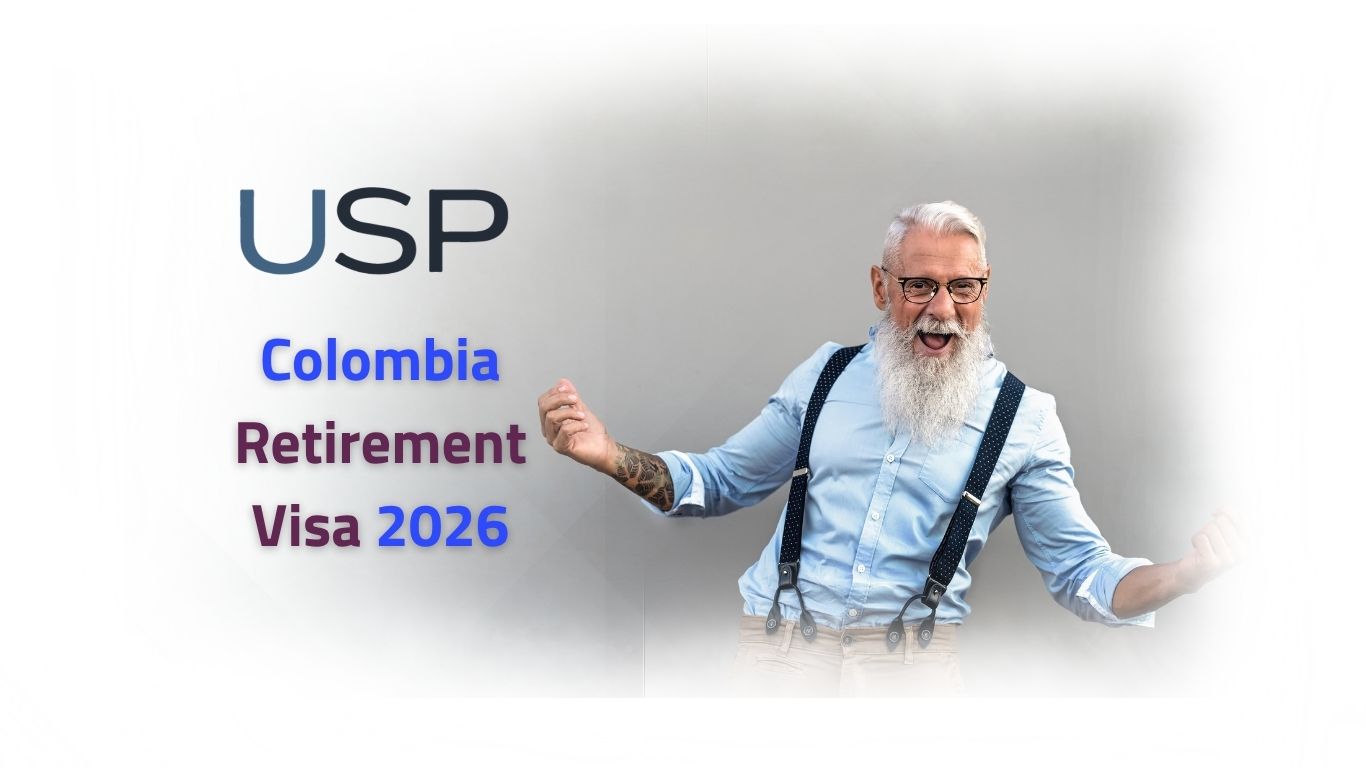
The Colombia Retirement Visa 2026 remains one of the most accessible paths to legal residency — and Colombia has become one of the most attractive retirement destinations in the world for good reason. The cost of living is a fraction of what you’d pay in the US, Canada, or Europe. The climate in cities like Medellín is comfortable year-round. Healthcare is affordable and high-quality. And the country offers a clear, well-established visa pathway for pensioners who want to make it official.
Key takeaways
- You need a lifetime pension of at least 3× the minimum wage: COP $5,252,715/month in 2026 (≈USD $1,375–1,420). US Social Security qualifies.
- The threshold is set in pesos — keep a buffer of at least 10% above the minimum to survive exchange-rate swings.
- The visa does not allow work and requires private health insurance — pensioner visa holders can’t rely on the public EPS system.
- Time counts toward residency: after 5 consecutive years you can apply for the Resident (R) visa, which grants indefinite residency.
In this guide
But “easy to qualify” doesn’t mean “impossible to get wrong.” At USP Consultancy, we see retirees run into preventable problems every month — usually not because they lack the income, but because their documentation wasn’t prepared correctly. This guide covers everything you need to know about the Colombia Retirement Visa in 2026, including what’s changed, what it actually costs, and the tax implications most agencies never mention.
What is the Colombia Retirement Visa 2026?
The Retirement Visa — officially the Visa M de Pensionado — is a Migrant-type visa designed for foreign nationals who receive a regular pension or retirement income. It falls under Resolution 5477 of 2022 and is one of the most straightforward visa categories available in Colombia.
Key facts: the visa is valid for one to three years depending on the discretion of the reviewing officer. It allows multiple entries and exits from Colombia, but you must return at least once every 180 days or the visa loses its validity. After five consecutive years holding an M-type visa, you become eligible to apply for a Resident Visa (Type R), which is the path to permanent residency and eventual Colombian nationality.
This visa does not permit you to work or engage in paid activities with any Colombian company or individual. It also does not grant access to Colombia’s public health system (EPS) — pensioner visa holders must maintain private health insurance.
Not sure whether the Retirement Visa or the Digital Nomad Visa fits you better? We compared them side by side: Digital Nomad Visa vs Retirement Visa (2026).
Income requirement for 2026
The core requirement is financial. You must demonstrate a monthly pension income of at least 3 times the Colombian minimum monthly wage (SMMLV).
For 2026, the SMMLV is COP $1,750,905. That means the minimum pension threshold is COP $5,252,715 per month — approximately USD $1,375–1,420, depending on the exchange rate applied when your application is reviewed.
A few important points about this requirement:
⚠️ The threshold is set in Colombian pesos, not dollars. Cancillería evaluates your income in COP. If the exchange rate moves against you between the time you gather your documents and the time your application is reviewed, you could fall below the threshold even if your dollar amount hasn’t changed. We recommend maintaining a buffer of at least 10% above the minimum.
The income must come from a pension. This is not a general income visa. Social Security benefits, government pensions, military pensions, company pensions, and private pension funds that pay a recurring monthly benefit all qualify. Investment income, savings withdrawals, or rental income alone do not satisfy this requirement.
U.S. Social Security is explicitly accepted. If your monthly Social Security benefit exceeds the threshold, you qualify. If it falls short, it can sometimes be combined with other qualifying pension income — but the documentation needs to be precise.
Required documents
- Valid passport — at least 6 months of validity and blank pages. You’ll submit a copy of the biographical page and the page with your most recent Colombian entry stamp (if you’re already in the country).
- Passport-sized photo — 3×4 cm, white background, front-facing, no accessories. Digital format only; printed photos are not accepted.
- Apostilled pension certificate — an official letter from your pension fund, Social Security Administration, or government agency confirming that you receive a lifetime monthly pension. It must clearly state the monthly amount, confirm the pension is ongoing (not temporary), and match your passport identity details exactly. If it’s not in Spanish, it needs an official translation by a certified translator.
- Bank statements — typically the last three months, showing consistent pension deposits that match the amounts in your pension certificate. The payer name should match the issuing entity on the pension letter.
- Criminal background check — issued by the competent authority of the country where you’ve resided for the last three years, apostilled and translated into Spanish. For U.S. citizens this means an FBI background check, apostilled by the U.S. Department of State.
- Health insurance — covering accidents, illness, hospitalization, disability, death, and repatriation of remains, valid in Colombia for the entire duration of your intended stay. Standard travel insurance typically does not meet these requirements.
- Psychophysical medical certificate — a medical fitness certificate confirming you are in adequate physical and mental health, introduced under Resolution 5477.
Application process
Step 1 — Gather and prepare your documents. This is where most problems occur. Pension letters that are vague about the monthly amount, background checks that aren’t properly apostilled, or health insurance that doesn’t include repatriation coverage — any of these can result in your application being delayed or rejected. Take the time to get this right, or work with a professional who knows what Cancillería expects.
Step 2 — Apply online through the Cancillería visa portal. Select Visa Type M and the Pensioner subcategory. Upload all documents in PDF format (total file size must not exceed 5 MB). Pay the study fee of USD $56 (COP $207,900).
Step 3 — Wait for review. The government has up to 30 calendar days to respond. During this period, Cancillería may request additional documentation. Respond promptly and completely — unanswered requests can lead to your application being archived.
Step 4 — Pay the issuance fee. If approved, the M-type visa issuance fee is USD $270 (COP $1,039,500).
Step 5 — Register with Migración Colombia. Within 15 calendar days of your visa being issued (or entering Colombia), register in person at a Migración Colombia office and apply for your Cédula de Extranjería — COP $294,000 (about USD $82). Do not skip this step — failure to register on time can result in fines.
Total costs
| Item | 2026 cost | Notes |
|---|---|---|
| Visa study fee | USD $54 (COP $207,900) | Non-refundable, paid on application |
| Visa issuance fee | USD $270 (COP $1,039,500) | Paid only if approved |
| Cédula de Extranjería | COP $294,000 (≈USD $82) | Migración Colombia, within 15 days |
| Document preparation | USD $150–400 (typical) | Apostilles, certified translations |
Source: Cancillería 2026 fee schedule; COP amounts at the official visa exchange rate in effect for 2026 payments. Government fees update periodically.
Professional fees depend on the service package that fits your case. For a detailed breakdown and a formal quote, start with a free Pre-Check.
The path to permanent residency
One of the most significant advantages of the Retirement Visa is that it counts toward permanent residency. After holding an M-type visa for five consecutive years, you become eligible to apply for a Resident Visa (Type R).
The R visa grants indefinite residency — it has no expiration date as long as you maintain the conditions that granted it (the visa document itself is simply transferred to your new passport every few years, and you lose the status only after more than 2 continuous years outside Colombia). It also opens the door to Colombian nationality if you choose to pursue it.
The key word here is consecutive. If your visa lapses — for example, because you stayed outside Colombia for more than 180 days — the clock resets. Planning your travel schedule carefully is essential if residency is your long-term goal.
Tax implications: the part most guides skip
If you spend more than 183 days in Colombia within any continuous 365-day period, you become a Colombian tax resident. This means you are legally required to declare your worldwide income to the DIAN (Colombia’s tax authority), including your pension income, investment returns, and any other earnings regardless of where they originate. The rule works the same for every long-stay visa — we explain it in depth in our guide to the 183-day rule and Colombian tax residency.
This catches many retirees off guard. You move to Colombia for the low cost of living, and then discover you have tax obligations in two countries simultaneously.
The good news: Colombia has tax treaties with several countries, and pension income treatment varies depending on the specific treaty and your country of origin. Understanding your obligations before you arrive — which treaty applies, what gets declared, what gets credited — keeps tax season from becoming an expensive surprise. It’s one more reason we keep visa and tax matters under one roof.
Common mistakes that delay or sink applications
Based on our experience processing retirement visas, here are the issues we see most frequently:
Pension letters that don’t clearly state a monthly amount. If your letter says “annual benefit of $18,000” instead of “monthly benefit of $1,500,” Cancillería may request clarification — adding weeks to your processing time.
Documents that aren’t properly apostilled. Every official document from your home country needs an apostille. For U.S. documents, this means the federal apostille from the Department of State (for FBI checks) or a state-level apostille depending on the document. Getting this wrong is the single most common reason for delays.
Health insurance that doesn’t meet the requirements. Your policy must explicitly include repatriation of remains and medical evacuation coverage. Many standard international health plans don’t include these provisions — check your policy carefully.
Missing the Cédula registration deadline. You have 15 days. If you miss it, the fine is steep. Put it on your calendar the day your visa is approved or you enter the country.
Not planning for the 180-day exit rule. If you plan to travel frequently or split time between Colombia and another country, track your days carefully. One miscalculation and your visa is cancelled.
Why work with USP Consultancy?
The Retirement Visa is one of the more straightforward visa categories in Colombia — but “straightforward” doesn’t mean “foolproof.” The difference between a smooth approval and a months-long delay often comes down to how your documents are prepared.
At USP Consultancy, we handle the full process: document review and preparation, apostille and translation coordination, application submission, and post-approval registration. We also help you understand what your life in Colombia looks like after approval — including what the 183-day rule means for you.
We’re based in Colombia. We work in English and Spanish. And we don’t process applications in bulk — every case gets individual attention from our team.
Wondering if your pension qualifies?
Tell us about your pension and your plans — we’ll tell you honestly whether you qualify and what it takes. We typically respond within 2 business hours (Mon–Fri, 8:30 AM – 5:30 PM COT).
Get a free Pre-Check Message us on WhatsAppSee the full service: Retirement (Pension) Visa — handled end-to-end
Frequently asked questions
How much pension income do I need for the Colombia Retirement Visa in 2026?
At least 3× Colombia’s minimum wage: COP $5,252,715 per month (about USD $1,375–1,420, depending on the exchange rate). The threshold rises every January with the minimum wage, so budget a buffer of at least 10%.
Does US Social Security qualify?
Yes — Social Security benefits are explicitly accepted, along with government, military, company, and private pensions that pay a recurring lifetime monthly benefit. Investment income or savings withdrawals alone do not qualify.
Can I work in Colombia on the Retirement Visa?
No. The Pension Visa does not authorize work or paid activities with Colombian companies or individuals. If you want to work, a different visa category is the way.
Can I join Colombia’s public health system (EPS) as a pensioner?
No — under Resolution 5477, pensioner visa holders must maintain private health insurance covering illness, hospitalization, and repatriation. Factor the policy cost into your retirement budget.
How long until I can get permanent residency?
After 5 consecutive years holding the M-type visa you can apply for the Resident Visa (Type R), which grants indefinite residency. “Consecutive” is the key word: if the visa lapses — for example by staying out of Colombia more than 180 days — the clock resets.
Will I pay taxes in Colombia on my pension?
If you spend 183+ days in Colombia in any 365-day window, you become a tax resident and must declare worldwide income — including your pension — to the DIAN. Whether you actually owe tax depends on deductions and any tax treaty with your country. Declaring and owing are not the same thing.
This article is for informational purposes only and does not constitute legal advice. Colombian visa requirements and internal criteria change frequently. Always consult a qualified professional before making immigration decisions.
Planning your move to Colombia?
See our Retirement (Pension) Visa service — we build your case and keep you updated at every step.
View the Retirement Visa →