⚖️ Legal Insight · Constitutional Court
Can Colombian bureaucracy block your path over a minor technicality?
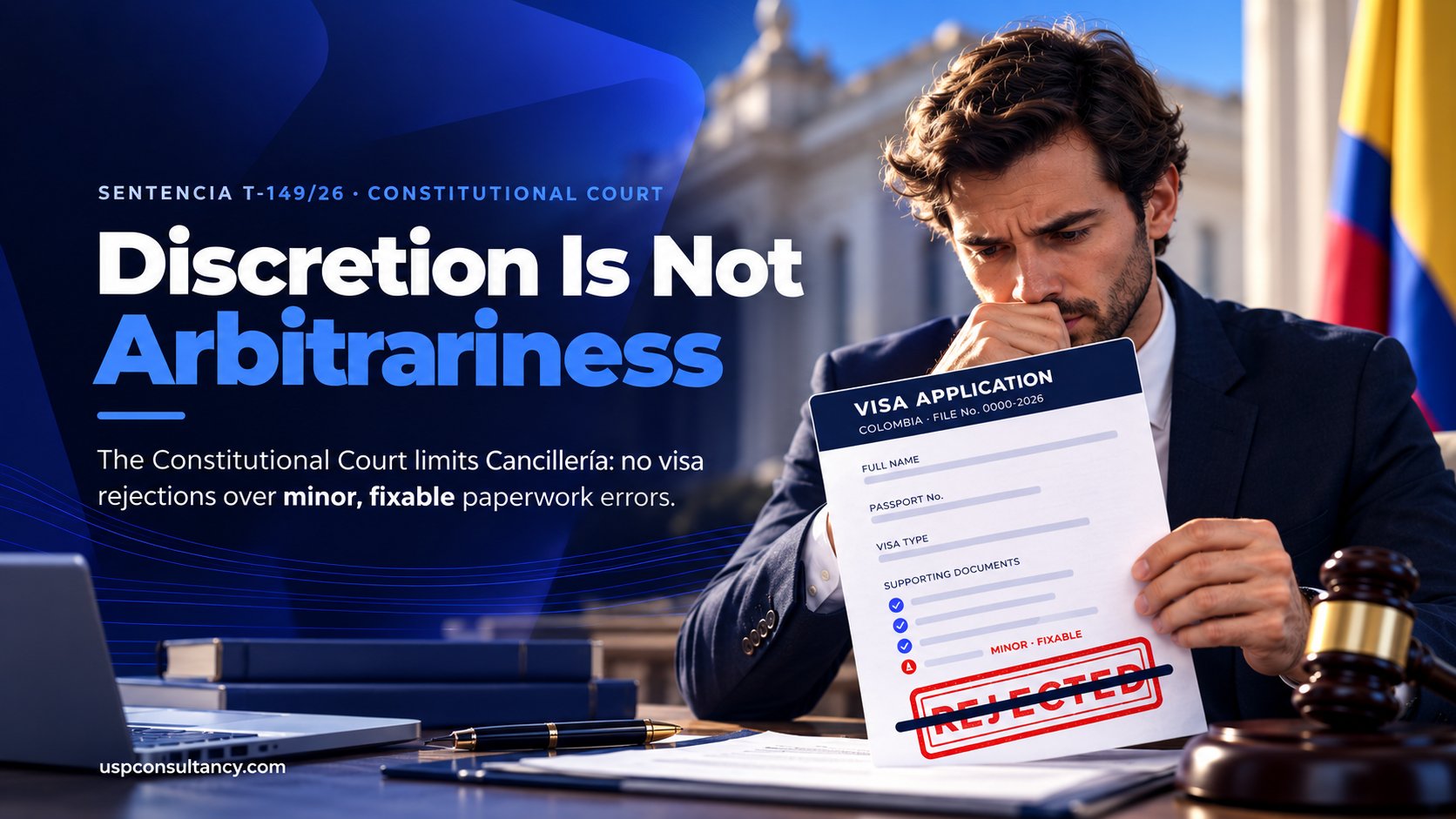
In the recent Sentencia T-149/26, the Constitutional Court drew a hard line against the Cancillería (Ministry of Foreign Affairs) regarding immigration and visa procedures.
Key takeaways
Discretion is not arbitrariness: The Colombian Constitutional Court ruled that the Ministry of Foreign Affairs (Cancillería) cannot use strict formalisms or technical paperwork hurdles to reject visa or immigration applications when errors are minor or easily fixable.
Internal Routing Duty: If an application goes to the wrong internal department or virtual channel within the entity, Cancillería cannot force applicants to start from scratch. They have a legal duty to forward the request internally to the competent office.
No Double Fees: Charging extra study fees due to administrative blocks or institutional rigidity is strictly prohibited.
Gender & Family Safeguards: Administrative bodies must apply a differential and gender perspective when evaluating migrant cases involving vulnerable applicants, ensuring that bureaucratic red tape never compromises family unity or the best interests of a child.
What did the Constitutional Court decide in Sentencia T-149/26?
Discretion doesn’t mean arbitrary rejection
Authorities cannot rely on “excessive ritualism” or rigid paperwork technicalities to deny applications when files are otherwise compliant.
Internal routing obligation
If your paperwork hits the wrong internal desk, the agency must reroute it internally, not force you to restart from zero.
No penalty fees
Unjustified double-billing for visa study fees caused by institutional bottlenecks is barred.
Family & gender protection
Bureaucratic hurdles can never override family unity, child welfare, or the protection of vulnerable applicants.
“
Immigration rules are meant to regulate, not to create endless bureaucratic mazes.
Source: Colombian Constitutional Court, Sentencia T-149 of 2026.
What does Sentencia T-149/26 mean for your visa application?
The ruling does not remove Cancillería’s discretion to grant or deny a visa. What it limits is how that discretion is used: a decision cannot rest on a paperwork formality the applicant could easily correct, and procedural mistakes inside the entity cannot be pushed back onto the applicant.
Practical points to keep in mind
- Keep proof of every submission. Save the application number, the date, the channel you used and the receipt for the study fee. If your request ends up in the wrong office, this record shows when and how you filed it.
- A misrouted request should be forwarded, not restarted. Under Sentencia T-149/26 and article 21 of Law 1437 of 2011, the competent office should receive your request through internal channels.
- Check before paying twice. If you are asked to pay the study fee again because of an internal block, the ruling is directly relevant to your case.
- Family circumstances matter. When children, a spouse or a vulnerable applicant are involved, the authority must weigh family unity and the best interests of the child.
Does Sentencia T-149/26 apply to every rejected visa?
No. It protects applicants against rejections based on minor, fixable formal errors and against internal procedural failures. A denial based on substantive grounds, such as not meeting the requirements of the visa category, is a different situation. Each file has to be reviewed on its own facts before deciding on the next step. If you are unsure whether your situation fits, our team can review the documents and the decision you received.
Was your visa application rejected over a technicality?
Reach out via Pre-Check and let our team evaluate your specific case.
Request your Pre-Check
Message us on WhatsApp
See our services: Colombia Visas
This article is for informational purposes only and does not constitute legal advice. Each case depends on its own facts; consult a qualified professional about your specific situation.