Updated October 16, 2026
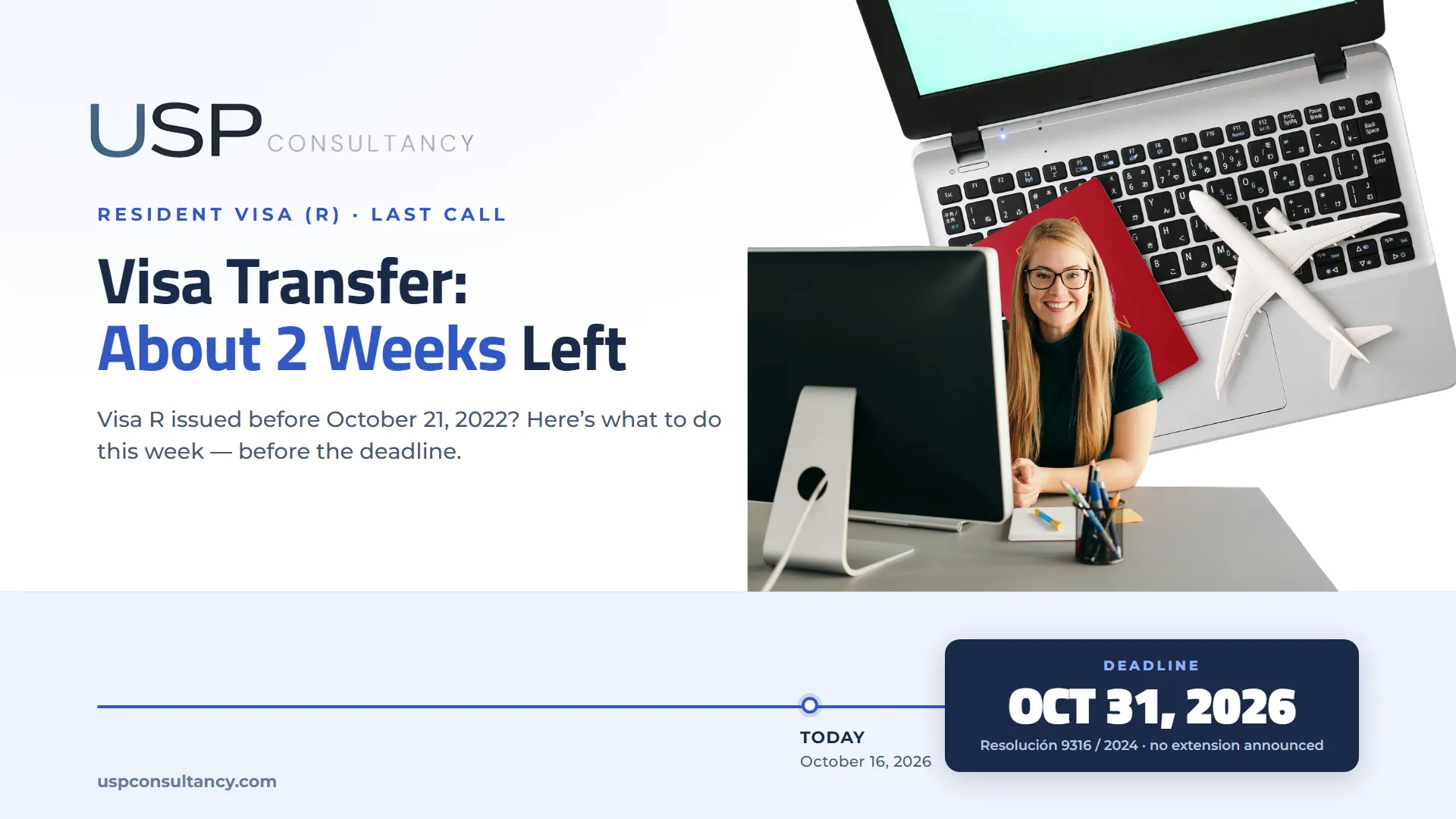
The Colombia resident visa transfer deadline is October 31, 2026. If you hold a Resident Visa (Type R) issued before October 21, 2022, you must complete the visa transfer (traspaso de visa) by then. That’s about two weeks away.
This is the short version: where things stand today, what to do this week, and the special cases that tend to slow people down. For the full walkthrough, see our complete guide to the resident visa transfer.
1. Where Things Stand Today
- The deadline is still October 31, 2026. It was set by Resolution 9316 of 2024, which extended the original 2024 deadline in Resolution 5477 of 2022. On September 15, 2026, Cancillería publicly reiterated this date, and as of today it has not announced another extension.
- Who it applies to: holders of a Resident Visa (Type R) granted under the rules in force before October 21, 2022, especially if the visa label has expired, is about to expire, or was issued with indefinite validity.
- You can apply from anywhere. The transfer is filed online, whether you are in Colombia or abroad.
- No Safe Conduct needed. Resolution 9316 removed the safe-conduct (salvoconducto) requirement for the transfer.
Don’t plan around October 31. Cancillería has up to 30 calendar days to decide, that period can be extended, and the current volume of applications is adding extra days or weeks. With about two weeks left, a single correction request can push you past the deadline.
2. Your Checklist for This Week
- Confirm you’re in scope. Check the issue date on your current visa. If it was issued before October 21, 2022, the transfer applies to you.
- Check your time outside Colombia. If you’ve been out of the country for more than two continuous years, your Resident Visa was lost by law, and a transfer won’t fix that. Talk to a specialist before you apply.
- Request your Certificate of Migratory Movements (Certificado de Movimientos Migratorios) from Migración Colombia. This is usually the document people wait on, so start here.
- Check your passport. It needs at least six months of validity and available pages.
- Gather the rest of the file: a copy of your current visa and Cédula de Extranjería, proof of your current activity (employment, occupation or income), a cover letter explaining the request, and a digital photo that meets the official specifications.
- Submit and pay the study fee on Cancillería’s online platform. Keep the confirmation.
- Watch your email. If Cancillería requests a correction, answer it quickly. Once approved, pay the issuance fee.
- Then renew your Cédula de Extranjería with Migración Colombia, based on the new visa.
Occasionally, Cancillería also asks for a criminal background check. If you’ve lived in Colombia for a long time, the national police certificate can be used.
3. Why the Last Weeks Before the Transfer Deadline Are the Riskiest
Most delays in a transfer don’t come from the legal requirements. They come from small things: a photo outside the technical parameters, a movement certificate that doesn’t match the passport, or a cover letter that doesn’t explain the request. Each of those can trigger a request for correction, and each round costs days.
We are now in the final two weeks. Every correction round counts — submit this week.
4. Special Cases
- Visas issued before 2000, without the original document. If you can’t present the original visa, Resolution 9316 lets you submit a sworn statement explaining why, together with an expanded Certificate of Migratory Movements covering the period since the year your visa was issued, and the last Cédula de Extranjería you were issued in Colombia.
- Living abroad. You can apply from outside Colombia. Keep the two-year rule in mind: continuous absence beyond two years means the visa was already lost.
- Reciprocity. Some nationalities pay reduced fees or are exempt under diplomatic reciprocity agreements. Check yours before paying.
5. Government Fees
| Study fee (Cancillería) | USD $56 |
| Issuance fee (Cancillería) — only after approval | USD $56 |
| Certificate of Migratory Movements (Migración Colombia) | COP $89,000 |
| Cédula de Extranjería (Migración Colombia) | COP $294,000 |
2026 government fees. Reduced rates or exemptions apply to some nationalities under reciprocity agreements.
6. What If You Miss October 31?
The document issued under the previous rules ceases to be valid once the deadline passes. That blocks the renewal of your Cédula de Extranjería and can cause problems with bank accounts, contracts, health and pension contributions, and border control.
Cancillería has not published how it will handle applications filed after October 31, 2026. We’ll update this post if it does. Until then, the safe move is to apply as soon as possible.
About two weeks left. Let’s check your file now.
Our free Pre-Check tells you whether the transfer applies to you and what’s missing from your file. Cancillería sets the timeline — our job is to make sure nothing in your file is what causes the delay.
Frequently Asked Questions
Has the October 31, 2026 deadline been extended?
No. As of October 16, 2026, Cancillería has not announced any extension. It reiterated the October 31, 2026 deadline on September 15, 2026, and Resolution 9316 of 2024 still applies.
Is it too late to start the transfer now?
No, but the margin is now very tight. Cancillería has up to 30 calendar days to decide, that period can be extended, and current volume is adding delays. Submit as early as you can so there’s time to answer any request for correction.
My visa was issued before 2000 and I don’t have the original. Can I still transfer it?
Yes. You can submit a sworn statement explaining why you can’t present the original, together with an expanded Certificate of Migratory Movements covering the period since your visa was issued, and your last Cédula de Extranjería.
Do I need a Safe Conduct for the transfer?
No. Resolution 9316 of 2024 removed the safe-conduct (salvoconducto) requirement for the resident visa transfer.
What happens if I miss the deadline?
The document issued under the previous rules ceases to be valid, which blocks the renewal of your Cédula de Extranjería and can affect banking, contracts, health and pension contributions, and border control. Cancillería has not published how late applications will be handled.
This content provides general information about Colombian immigration law. It is not legal advice for your specific case. Cancillería sets the timeline for each application. For your case, request a Pre-Check or schedule a consultation.